
The Reality of Negative Cash Flow Most Landlords Miss
Buy-to-let in South Africa is no longer the passive income strategy many investors were sold. This piece breaks down the real financial and legal pressures shaping the market today, why traditional rental models are under strain, and what experienced landlords are starting to consider instead. Discovery old (but underutilized) structured exits and alternative ownership strategies that reduce exposure while preserving upside. If you’re a landlord feeling the pressure, this is a realistic look at where the market is heading—and what options still exist.
SELLINGPRIVATE SALERENTALSEVICTIONS
Kobus Taljaard
4/30/20265 min read
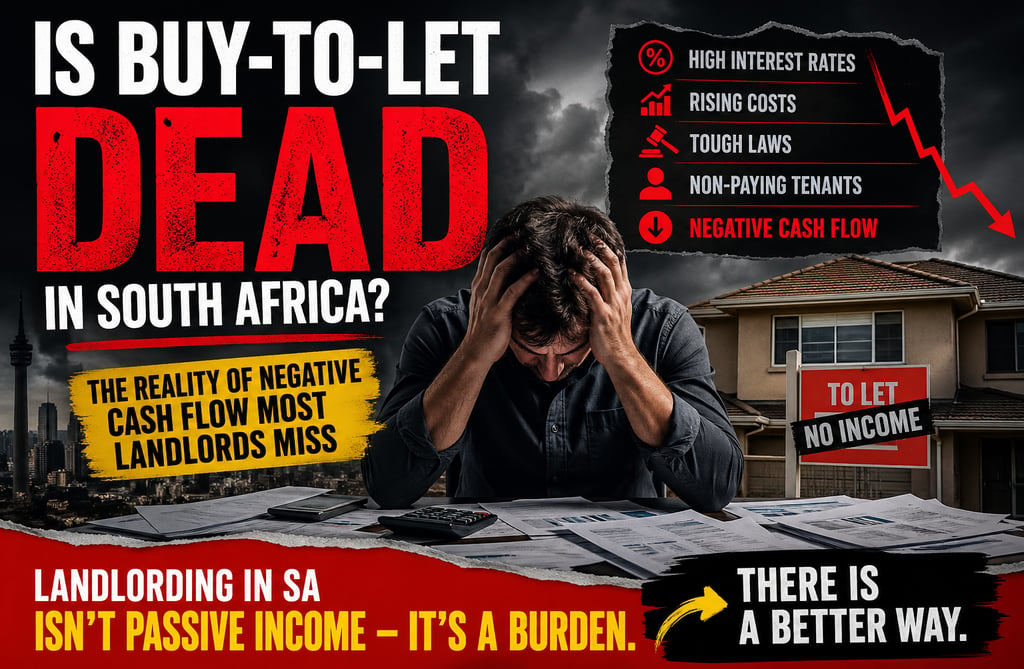
Is Buy-to-Let Dead in South Africa? The Reality of Negative Cash Flow Most Landlords Miss
It Was Supposed to Be Simple
Buy a property. Rent it out. Let the tenant pay your bond.
That's the model most South African landlords bought into.
For years, it worked—at least on paper. Property values rose, tenants were relatively stable, and the idea of "passive income" through real estate became almost unquestioned.
But that model is breaking down.
Quietly.
Not in headlines. Not in dramatic crashes. But in spreadsheets, bank accounts, and sleepless nights.
Because today, more landlords are discovering something they never planned for:
Their rental property is costing them money every single month.
The Shift No One Budgeted For
The modern South African buy-to-let environment is no longer defined by yield—it's defined by pressure.
Rising Borrowing Costs
Interest rates have remained elevated. Most rental properties are financed through variable-rate bonds, which means every interest rate hike translates directly into higher monthly obligations.
What used to be a manageable repayment has, for many, become a persistent financial strain.
Municipal Escalation Without Service
Then layer in municipal costs.
Rates. Taxes. Electricity. Water. Refuse.
These are no longer predictable line items. In many areas, they're rising faster than inflation—often without corresponding improvements in service delivery.
You're paying more for less.
The Maintenance Obligation
As a landlord, you're not maintaining an asset for pleasure—you're maintaining habitability. That's a legal standard under South African rental law, not a preference.
Whether the tenant pays or not, the obligation remains.
Add insurance. Add vacancy risk. Add compliance costs.
What you're left with is not a passive investment.
It's a system that requires constant financial input just to remain stable.
When the Numbers Turn Against You
At some point, the equation flips.
Rental income no longer covers:
The bond repayment
The municipal costs
The ongoing upkeep
And the gap?
You carry it.
Month after month.
This is what negative cash flow looks like in practice—not as a temporary dip, but as a sustained position where the asset you own is actively draining your liquidity.
Many landlords justify it.
They tell themselves:
"It's long-term." "Property always goes up." "I'll make it back when I sell."
But that assumes stability.
And stability is exactly what the current environment doesn't offer.
The Risk Most Landlords Underestimate: The Legal Reality
The real problem isn't just financial.
It's legal.
South Africa's rental framework is built on protections—necessary protections—but ones that create a very specific reality for landlords.
The PIE Act and Court-Driven Evictions
Under the Prevention of Illegal Eviction from and Unlawful Occupation of Land Act (PIE Act), removing a tenant is not a procedural action.
It's a judicial process.
Courts must consider:
The tenant's circumstances
The availability of alternative accommodation
The broader context of fairness and equity
In parallel, the Rental Housing Act (RHA) governs the relationship itself—placing strict obligations on landlords around leases, inspections, and dispute handling.
On paper, this creates balance.
In practice, it creates delay.
And delay, in a negative cash flow environment, is expensive.
The Compounding Scenario: A Non-Paying Tenant
Consider a situation that is becoming increasingly common:
A tenant falls into arrears.
Not immediately. Not dramatically.
At first, it's partial payments. Late payments. Promises.
Then, eventually, no payment.
At that point, your options narrow dramatically.
What You Cannot Do
You cannot:
Remove the tenant yourself
Change the locks
Cut utilities
Take "self-help" measures
Doing so exposes you to legal consequences, including restoration orders and potential damages.
What You Must Do
So you follow the process.
You issue notices. You engage legal assistance. You initiate eviction proceedings.
And then you wait.
Six months. Twelve months. Sometimes longer.
During that time:
The tenant remains in the property
The income is reduced or nonexistent
The costs continue in full
Bond. Rates. Maintenance. All of it.
This is not a worst-case scenario.
This is a known risk profile.
"Just Fix It" — What That Actually Means
From the outside, the solution seems straightforward:
"Just evict the tenant."
But in practice, fixing the problem requires precision at every stage.
Stage 1: Compliance and Documentation
It starts with compliance.
You need:
A legally sound, written lease (mandatory under the Rental Housing Act)
Documented inspections
Clear records of communication and payment
Data handling that aligns with the Protection of Personal Information Act (POPIA)
Even data management must be precise. If your documentation is incomplete or flawed, your position weakens before the process even begins.
Missing a single requirement can reset the entire timeline.
Stage 2: Legal Notices and Procedures
Then comes enforcement.
Legal notices must be issued correctly. Procedures must be followed precisely. Court applications must be prepared and filed.
At this stage, most landlords involve attorneys—not because they want to, but because the margin for error is small.
Legal costs can escalate quickly:
R20,000 to R100,000+ depending on complexity and court delays
And even when everything is done correctly, time is not guaranteed.
Court backlogs. Administrative delays. External dependencies.
There is no fast track.
There is only process.
The Hidden Cost: It's Not Just Money
What doesn't show up in spreadsheets is the operational burden.
The calls. The follow-ups. The uncertainty.
The constant awareness that something unresolved is sitting in the background, costing you money and attention.
Over time, this accumulates.
Not as a single breaking point—but as fatigue.
And that's where the real shift happens.
Because eventually, the question changes.
Not:
"How do I fix this?"
But:
"Why am I still doing this?"
Exiting Isn't Failure — It's Strategy
There's a persistent belief among landlords that selling means giving up.
That if you exit, you've somehow failed to make the model work.
But that assumes the model itself is still optimal.
And in the current environment, that's not always true.
Exiting a property that no longer performs—financially or operationally—is not a loss of discipline.
It's an application of it.
It's choosing:
Liquidity over stagnation
Simplicity over complexity
Control over exposure
You Don't Have to Walk Away From Property Income
This is where most people make a false assumption.
They think the only options are:
Continue renting, OR
Exit completely
But property is not a single strategy.
It's a category.
And within that category, there are multiple ways to structure income—many of which don't carry the same operational burden as traditional renting.
Some investors move toward:
Structured sale agreements
Lease-option models
Hybrid finance arrangements
Partnership-based deals
Others reposition themselves entirely—shifting from managing tenants to structuring transactions.
The common thread?
They reduce:
Direct tenant risk
Day-to-day management
Legal exposure
And increase:
Control over terms
Predictability of returns
You don't need to master these strategies overnight.
But you should at least know they exist.
Because once you do, the idea that "renting is the only way to make money from property" starts to fall apart.
The Real Decision
At this point, most landlords find themselves in one of two positions:
Either:
They're still trying to make the current model work.
Or:
They're quietly considering something else.
Not out of panic.
But out of clarity.
Because when you strip everything back, the question is simple:
Is this property still serving you—or are you serving it?
A Straight Answer
If your rental property:
Is running at a loss
Is carrying increasing risk
Is taking more time and energy than you expected
Then it's reasonable to reconsider the structure.
Not emotionally.
Strategically.
And if you've reached the point where you're done—truly done—with the burden of being a landlord, there are ways to exit cleanly.
There are also ways to stay in property without staying in landlording.
Next Steps: Let's Get You an Offer
If you're tired of the model… If the numbers no longer make sense… If you want out without dragging the process out for months or years…
No games. No drawn-out negotiations.
Just a straightforward conversation about what you have, what you want, and whether there's a fit.
Because at the end of the day, property should work for you.
Not the other way around.
Get in touch


kobus@webuySAhomes.co.za
(083) 232-7597
© 2025 Nine Stones Capital (Pty) Ltd T/A "We Buy SA Homes". All rights reserved.
Real Estate Investor | Cash Buyers | Serving every province in South Africa | Privacy Page
Bellville ● Cape Town ● Gordons Bay ● Johannesburg ● Pretoria ● Durban ● Durbanville ● Bloemfontein ● Port Elizabeth ● East London ● Polokwane ● Nelspruit ● Pietermaritzburg ● George ● Knysna ● Plettenberg Bay ● Jeffreys Bay ● Langebaan ● Upington ● Potchefstroom ● Sandton ● Somerset West ● Stellenbosch ● Strand ● Paarl ● Wellington